SET STANDARD · Preparation guides
Pilot Technical Interview: Key Topics and How to Explain Them
Updated October 2026
The technical interview checks two things at once: what you know and how well you can explain it. Airlines are not looking for a walking textbook. They want a pilot who understands the principles behind daily operation, can connect theory to the cockpit and can admit the limits of their knowledge without bluffing.
This page covers the topics that come up most often, aerodynamics, performance, meteorology, systems and operational rules, with brief model explanations to help you structure your own answers. Use them as a starting point and always check the details against your current manuals and the applicable regulations.
How the technical interview works
It is usually conducted by one or two line pilots or training captains. Some airlines use a fixed set of questions; others start with your background and follow the conversation. Type-rated candidates should expect questions on their current aircraft, while cadets are typically asked about ATPL theory and its practical meaning.
A good answer starts simple, uses correct terminology and adds depth only when asked. Drawing a quick sketch, if a whiteboard or paper is available, can make explanations clearer.
Aerodynamics
Expect questions on lift, drag, stall and high-speed flight. Lift depends on air density, the square of true airspeed, wing area and the lift coefficient, which in turn depends mainly on angle of attack and configuration. A wing stalls when it exceeds its critical angle of attack, which is why stall can occur at any speed or attitude.
In a level turn the load factor increases, so the stall speed rises with the square root of the load factor. At high altitude, the margin between the low-speed buffet and the high-speed limit narrows; this is the so-called coffin corner. Swept wings delay compressibility effects but bring characteristics such as Dutch roll, which is damped by a yaw damper on most jets.
- Lift equation and the factors in it
- Induced versus parasite drag and the minimum drag speed
- Effect of flaps, slats and contamination on the wing
- Critical Mach number and buffet margins
Performance
Performance questions often focus on take-off. V1 is the maximum speed at which the crew can initiate a rejected take-off and, at the same time, the minimum speed at which the take-off can be continued after an engine failure and still meet the required performance. VR is the rotation speed and V2 the take-off safety speed reached by a specified height with one engine inoperative.
Be ready to explain declared distances (TORA, TODA, ASDA, LDA), the roles of clearway and stopway, and why high temperature, high elevation, a tailwind, an uphill slope or a contaminated runway reduce performance. Reduced-thrust take-off using an assumed temperature is another frequent topic.
- Definitions of V1, VR and V2 and why their order matters
- Factors that limit take-off weight: field length, climb, obstacles, tyres, brakes
- Landing distance on dry versus contaminated runways
Meteorology
Interviewers often ask about phenomena that directly affect safety. The ICAO Standard Atmosphere assumes 15 °C and 1013.25 hPa at mean sea level with a temperature decrease of about 2 °C per 1,000 ft up to the tropopause. Real conditions differ, which is why temperature corrections and density altitude matter.
Cumulonimbus clouds combine severe turbulence, icing, hail, lightning and windshear, including microbursts near the ground. Airframe icing requires visible moisture and temperatures at or below freezing, with supercooled droplets being particularly hazardous. You should also be able to decode a METAR and TAF fluently and describe fronts, jet streams and clear-air turbulence.
Aircraft systems
Type-rated candidates should know their current aircraft at architecture level: how many hydraulic systems there are and what they power, the electrical generation and distribution logic, the pressurisation and bleed air system, fuel system, and flight control philosophy. On Airbus fly-by-wire aircraft, for example, be ready to explain the control laws and the protections available in each.
Cadets are more likely to be asked about generic principles: how a turbofan works, what N1 and EGT indicate, why aircraft are pressurised and what happens during a decompression. Clarity matters more than detail.
Operations and regulations
European candidates should understand the structure of EU air operations rules and how they appear in an operator's manuals. Common questions cover fuel planning and its components, alternate aerodrome requirements, flight time limitations, the minimum equipment list and stabilised approach criteria.
Explain the logic rather than reciting numbers you are unsure of. For example, a stabilised approach exists because predictable energy and configuration reduce the risk of runway excursions; if the criteria are not met at the stated gate, the expected action is a go-around.
- Fuel policy and final reserve fuel
- Destination and take-off alternates
- Flight and duty time principles
- MEL philosophy and dispatch with inoperative items
How to prepare efficiently
Revise the core ATPL subjects with a practical focus, then go deep on the aircraft you fly or the one the airline operates. Practise explaining each topic aloud in under two minutes. If you do not know something during the interview, say so and reason from first principles. SET STANDARD's airline-specific assessment guides list the technical areas each operator tends to emphasise, which helps you prioritise your revision.
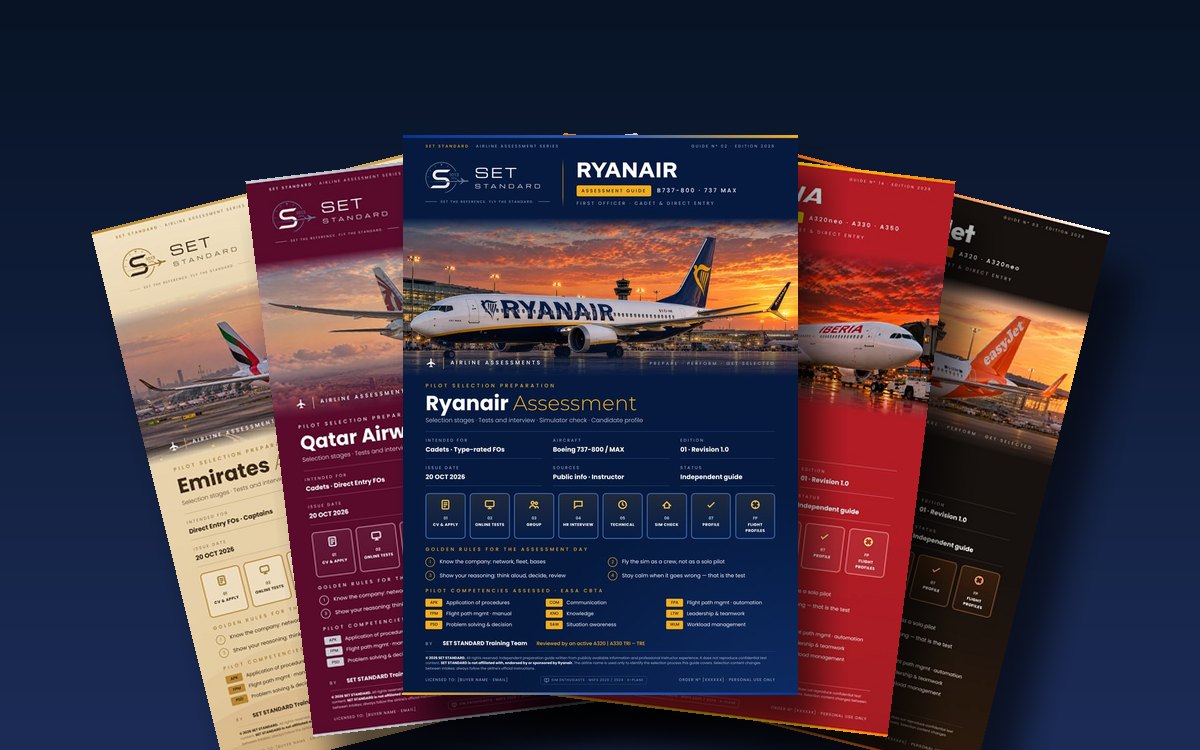
Airline-specific assessment guides
158 operator guides in the catalogue, 95–235 pages each, edition 2026: process, tests, interview, technical refresher and simulator profile.
Choose your airlineFrequently asked questions
How deep do technical interview questions go?
It depends on the airline and your experience. Cadets are usually asked about principles; type-rated pilots should expect detail on their current aircraft and operational rules.
Will I be asked about the airline's aircraft if I have never flown it?
Sometimes at a general level, to see your interest and preparation. Knowing the basic characteristics of the airline's fleet is a good idea.
Is it acceptable to say I do not know?
Yes. Admitting a gap and explaining how you would find the answer is far better than guessing. Honesty is part of what is being assessed.
Should I study from the ATPL question bank?
Question banks help with recall, but interviews test understanding. Combine them with textbooks, manuals and practice explaining concepts aloud.
How long should I spend preparing for the technical interview?
Several weeks of regular revision is typical. Experienced pilots may need less, but should still refresh theory they do not use daily.