SET STANDARD · Preparation guides
Pilot Group Exercise: How to Show Real Crew Behaviour
Updated October 2026
The group exercise is the stage of airline selection that candidates most often misread. Many arrive thinking they must win the discussion, take charge or produce the cleverest solution. In reality, assessors are watching something much closer to the flight deck: how you communicate, cooperate and help a team reach a safe, timely decision.
This guide explains the usual formats, the behaviours that are observed and the habits that make a positive impression. Because the exercise is about behaviour rather than knowledge, the best preparation is understanding what good teamwork looks like and practising it in realistic conditions.
Why airlines use a group exercise
Modern airline operations depend on crew resource management. A technically excellent pilot who cannot work with a colleague, listen to cabin crew or accept input from others is a safety risk. The group exercise gives assessors a chance to see interpersonal behaviour under mild pressure, something that tests and interviews cannot show directly.
It also reveals how you behave with strangers. On the line you will often fly with people you have never met, so the ability to build a working relationship quickly matters.
Finally, the exercise shows how you handle mild stress and ambiguity. The brief is often incomplete, time is short and opinions differ. Staying calm, organised and courteous in that situation is a good indicator of how you will behave when a flight does not go to plan.
Typical formats
Groups commonly consist of four to eight candidates with one or more assessors observing. You receive a brief, a limited amount of time and a task that requires discussion and a joint outcome. Some exercises give every participant the same information; others give each person partial information that must be shared.
The topic is frequently not about aviation at all, precisely so that technical knowledge does not dominate. When it is aviation-related, it tends to be a planning or prioritisation problem rather than a test of systems knowledge.
- Ranking or prioritisation tasks with limited resources
- Planning problems with time, distance or cost constraints
- Scenarios requiring a joint decision and a short presentation
- Practical or building tasks completed as a team
- Discussion of a case with conflicting objectives
Behaviours assessors observe
Assessors usually work with a behavioural checklist linked to the airline's competency framework. They record specific, observable actions rather than general impressions, so what you actually say and do is what counts.
Positive markers include listening and building on others' ideas, summarising progress, managing time, inviting quieter members to contribute, stating your view clearly with reasons and accepting a better proposal gracefully. Negative markers include interrupting, ignoring input, pushing a personal agenda, withdrawing or criticising people rather than ideas.
- Communication: clear, concise, respectful, checks understanding
- Teamwork: supports others, shares information, seeks consensus
- Leadership: gives direction when needed without dominating
- Decision making: structures the problem and reaches a timely conclusion
- Workload management: keeps an eye on time and priorities
Roles: you do not need to be the leader
A frequent myth is that the person who leads the group scores highest. Leadership is valued, but so are followership, timekeeping, summarising and challenging assumptions constructively. A candidate who quietly makes sure the team meets the deadline and that every member has been heard can perform excellently.
If nobody organises the discussion, proposing a simple structure is helpful. If someone else has already done it, support that structure rather than competing with it. This is exactly how a well-functioning crew works.
Do: habits that make a good impression
Good behaviour in a group exercise is simple to describe but harder to maintain under pressure. Practise these habits in study groups or mock sessions until they feel natural.
- Read the brief carefully and clarify the goal with the group before diving in
- Suggest a time plan and keep track of it
- Use names and refer back to others' points
- Summarise where the group stands at key moments
- Give reasons for your opinions and be ready to change them
- Make sure the group delivers an answer within the time limit
Don't: behaviours that raise red flags
Some behaviours are almost always noted negatively, regardless of how good your ideas are. Being aware of them is often enough to avoid them.
- Talking over others or repeating your point louder
- Staying silent for long periods and contributing nothing
- Arguing with the assessors or questioning the exercise
- Dismissing ideas without explanation
- Playing a role you think assessors want instead of being yourself
- Losing track of time and leaving the task unfinished
How to prepare
Practise with other candidates or colleagues using short, time-limited problems, and ask someone to observe and give feedback on specific behaviours. Reflect on how you naturally behave in groups: if you tend to dominate, practise asking questions; if you tend to hold back, practise making your first contribution early. Reviewing your own behaviour in past team situations, at work, in sport or during training, also gives you material for the interview.
Formats differ between airlines. SET STANDARD's airline-specific assessment guides describe the type of group exercise each operator has used in recent campaigns, which helps you prepare for the right setting.
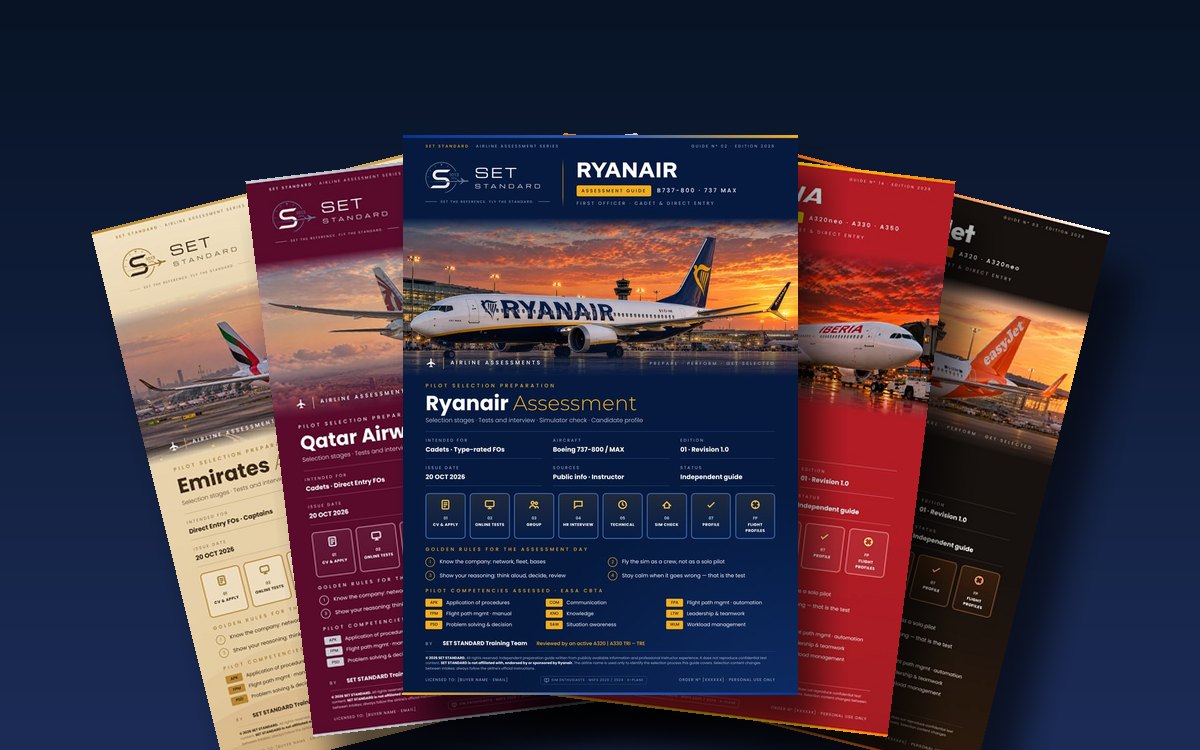
Airline-specific assessment guides
158 operator guides in the catalogue, 95–235 pages each, edition 2026: process, tests, interview, technical refresher and simulator profile.
Choose your airlineFrequently asked questions
Is the group exercise about aviation knowledge?
Usually not. Many exercises use non-aviation topics on purpose so that behaviour, not technical knowledge, is what assessors observe.
Should I try to take the lead in the group exercise?
Only if the group needs it. Leadership is one positive behaviour among many; supporting, summarising and timekeeping are also valued.
What if the group reaches a decision I disagree with?
State your view with reasons, listen to the counter-arguments and then support the group decision. Constructive disagreement followed by commitment is a good crew behaviour.
Does it matter if the group reaches the wrong answer?
The process normally matters more than the answer. However, a group that never reaches a conclusion within the time limit shows weak decision making.
How many candidates usually take part?
It varies, but groups of four to eight candidates are common, observed by one or more assessors.