Selection process · tests · interview · simulator check
Air Canada pilot assessment
Updated October 2026 · SET STANDARD
Air Canada Assessment GuideLeave your email and we send you one message the day it is released.
Notify meAir Canada still recruits Canadian-licensed First Officers in 2026, mainly through the Jazz flow and direct-entry postings, while a fuel-driven capacity trim, a CEO handover and big fleet changes (A321XLR, 787-10, 737 MAX to Rouge) shape the pace of classes.
Get an email when the Air Canada guide is released
One email when it is out. No newsletter unless you ask for it.
While you wait
These guides are available now and cover the same preparation.
- Southwest Airlines Assessment Guide
A complete U.S. major-airline selection guide: hiring process, interview, technical and the Southwest culture.
- FAA ATP Conversion
For EASA/ICAO pilots: the route to an FAA ATP and a U.S. airline job.
- Cleared for Selection
The universal pilot-assessment handbook: tests, interview, group exercise and simulator check, for any airline.
Air Canada is Canada's largest airline and flag carrier, headquartered in Montreal, with global hubs in Toronto, Montreal and Vancouver. Together with Air Canada Rouge (leisure) and Air Canada Express (regional flights by Jazz and PAL Airlines) it serves about 200 airports on six continents, and it was a founding member of Star Alliance. Created by Parliament in 1937 as Trans-Canada Air Lines, it became Air Canada in 1965, was privatised in 1988-89, absorbed Canadian Airlines in 2000 and restructured under CCAA protection in 2003-04.
Key facts
| Fleet | Mainline 225 (Mar 2026): 42 A220-300, 22 A320, 21 A321, A321XLR (first Apr 2026, about 6 by mid-2026), 20 A330-300, 49 737 MAX 8 (moving to Rouge), 6 777-200LR, 19 777-300ER, 8 787-8, 32 787-9, 6 767F. Rouge 35 (A319/A320/A321/737 MAX 8). Express 95 (CRJ900, E175, Dash 8-400) |
|---|---|
| Orders | 30 A321XLR (total), 23 A220-300, 14 787-10 (first by end 2026), 8 A350-1000 + 8 options (from 2030), 30 Heart ES-30 (2029+) |
| Bases | Pilot bases YYZ, YUL, YVR; YYC and YWG listed on some postings; Toronto A321XLR base opening late 2026 |
| Pilots | About 5,200-5,700 mainline and Rouge pilots on one seniority list, represented by ALPA |
| Hiring 2026 | Rolling postings for experienced Canadian ATPL holders; volume not published; 2026 capacity growth cut to 2.25-3.25% |
| Entry routes | Direct-entry FO (2,000 h, Canadian ATPL), Jazz flow (Air Canada Express), partner pathways (Chartright); no DE captain, no in-house ab initio |
Entry routes and requirements
Direct-entry First Officer (mainline and Rouge, single seniority list)
Experienced Canadian-licensed pilots from regionals, charter, corporate, cargo, northern operators or the RCAF (applications marked 'for non AC Express pilots')
- Minimum 2,000 h fixed-wing flying time (posted minimum; successful applicants usually well above)
- Transport Canada Airline Transport Pilot Licence - Aeroplane (ATPL-A)
- Current Group 1 (multi-engine) instrument rating
- Transport Canada Category 1 medical, meeting Air Canada visual acuity standards
Air Canada Express flow (Jazz Aviation) incl. Jazz cadet routes
Low-time and mid-career pilots who want to reach Air Canada via its main regional partner
- Jazz FO: 500+ h, Canadian CPL, Group 1 IFR, Category 1 medical, licensed for 705 FO duties, Canadian citizen or PR, able to enter the U.S.
- Jazz Direct (affiliated college graduates): 250+ h, min 80% on specified TC exams, no flight-test failures, faculty recommendation
- Jazz Approach: integrated ATPL cadet programme (about 18-20 months) at Cygnet Aviation Academy with jet transition at CAE Toronto; conditional offer from Jazz on selection
- Seneca Jazz Cadets / Jazz Awards: top graduates of partner colleges get a guaranteed interview and sim evaluation
Partner development pathways (PAL Airlines, Chartright)
Pilots flying for Air Canada Express partner PAL Airlines or for corporate operator Chartright
- PAL Airlines (Air Canada Express Dash 8-400 operator; agreement renewed to 2032): reported 500-750 h, Group 1 IFR, Category 1 medical, Canadian citizen or PR
- Chartright programme (announced March 2026): three years in the light-jet (Citation) programme, at least two as captain, before an Air Canada interview
The selection process, step by step
- Online applicationonline (careers.aircanada.com)
Profile, CV, cover letter and detailed flight-time breakdown against the posting. Air Canada states applications far exceed vacancies and favours candidates who exceed the minimums.
- Online assessments (reported)online
Candidates report computer-based testing that combines aviation knowledge (regulations, procedures, systems) with cognitive/aptitude items and a personality questionnaire. Vendor not published.
- Panel interviewin person or video (reported)
Panel of Air Canada pilots, often with an HR representative; mostly behavioural and situational questions, some technical and company knowledge.
- Simulator assessmentsimulator
Reported crew-style evaluation in an Air Canada full flight simulator at the Montreal training centre (some candidates report Toronto). Hand-flying, instrument skills and multi-crew coordination.
- Conditional offer, medical and securityadministrative
Conditional job offer, Air Canada/Transport Canada medical and vision checks, references, RAIC/Transport Canada security clearance and background checks before a class date.
- New-hire coursetraining
Indoctrination, CARs/company procedures and type rating on the first assigned fleet (A220, A320 family, 737 MAX or as relief pilot on widebodies, by seniority and need).
Aptitude and psychometric tests
- aviation knowledge (multiple choice)
- cognitive / reasoning
- spatial and multitasking
- personality questionnaire
Not published; candidate reports only
The interview
Panel of Air Canada line or training pilots plus HR (reported), about 45-60 minutes, behavioural and situational with some technical and company questions
- Why Air Canada
- Safety and CRM
- Teamwork and openness to change
- Customer and official-languages awareness
- Judgement in operational scenarios
Typical questions to prepare
- Why Air Canada?
- Tell us about yourself.
- What do you know about our fleet renewal?
- What is the difference between Air Canada, Rouge and Air Canada Express?
- Tell us about a time you disagreed with a captain.
- Describe a mistake you made in flight.
The simulator assessment
| Device | Full flight simulator (reported A320-family style; type not published) |
|---|---|
| Where | Air Canada training centre, Montreal (YUL) (reported; Toronto also reported) |
| Typical profile | Reported crew session: briefing, departure, raw-data or manual handling, an abnormal or engine failure, approach and possible go-around. Focus on CRM and standard procedures rather than type knowledge. |
Language and after selection
ICAO English Level 4 minimum; French is an asset and valued because Air Canada is subject to the Official Languages Act; bilingualism helps base and route flexibility.
New-hire training in Montreal (Air Canada training centre near YUL) and type rating on an assigned fleet; base assignment by seniority across YYZ, YUL, YVR and smaller domiciles (YYC/YWG listed on some postings). Some new hires start as relief pilots on long-haul widebodies.
Common reasons candidates fail
- Not meeting the legal basics: no Canadian citizenship or PR, or no Transport Canada ATPL
- Logbook and application figures that do not match
- Generic 'Why Air Canada?' with no knowledge of hubs, fleet renewal or Rouge/Express structure
- Weak STAR stories without a clear outcome or lesson
- Poor CRM in the sim: no briefing, silent flying, ignoring the PM
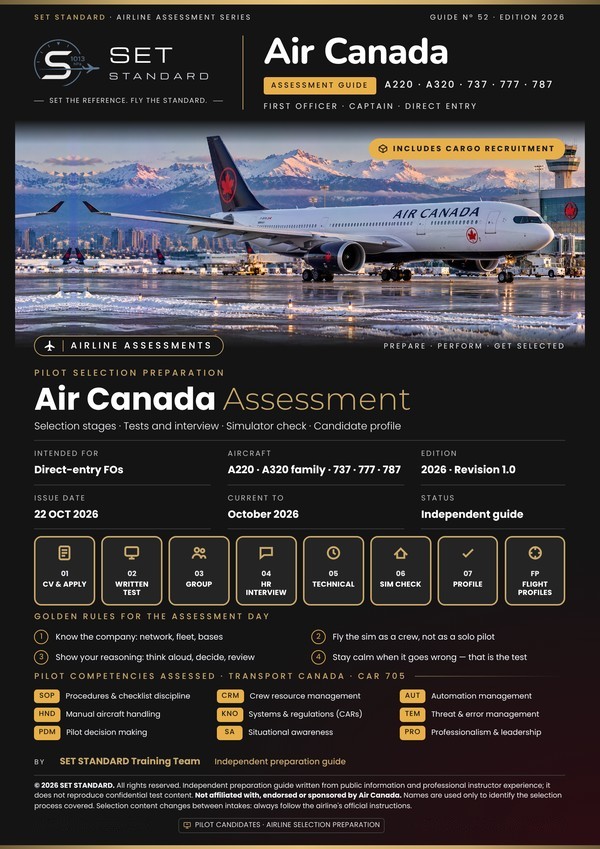
Get the complete Air Canada Assessment Guide
220 pages: company history and culture, every stage of the selection, model interview answers, technical refresher, A220 · A320 family · 737 MAX · 777 · 787 · A330 systems and simulator assessment preparation. Updated for 2026.
Look inside the guideStatus: Preview · current to October 2026 · not on sale yet · join the waiting list
About this guide
- Format
- PDF (bookmarked, iPad-optimised)
- Language
- English
- Edition
- Ed 2026 · Revision 1.0
- Current to
- October 2026
- Pages
- 220
- Status
- Preview · not on sale yet
- Licence
- Personal, single user · see licence terms
- Updates
- Update policy to be announced before sales open
- Simulator stage
- Covered as reported by candidates and public sources
Independent publication. Facts in this overview are labelled “reported” when they come from candidate reports rather than official sources — see the editorial standards. Notify me about this guide · See it in the catalogue
Practice questions: company knowledge
Interview practice drawn from public sources; the answers are not an FAQ about the guide.
Where is Air Canada headquartered?
Montreal (Saint-Laurent), at Montreal-Trudeau airport
What were Air Canada's original name and founding year?
Trans-Canada Air Lines, 1937
When did TCA become Air Canada?
1 January 1965
What are Air Canada's three hubs?
Toronto Pearson, Montreal-Trudeau and Vancouver
Which alliance did Air Canada co-found in 1997?
Star Alliance
Who was named Air Canada's next CEO in July 2026?
Anko van der Werff, CEO of SAS, starting by the end of January 2027
Preparation guides
Other airline assessments
Main sources
https://careers.aircanada.com/ca/en/job/AIPACICA38766EXTERNALENCA/Pilot-for-non-AC-Express-Pilots-only
https://pilotsglobal.com/job/B737-MAX-first-officer-air_canada-CA-e6156139d0
https://pilotsglobal.com/job/AC-on-Seniority-first-officer-air_canada-CA-f2c4e2a4be
https://www.pilotaudit.com/canada/air-canada-pilot-requirements
https://rotatepilot.com/airlines/air-canada/recruitment
SET STANDARD is an independent training publisher, not affiliated with Air Canada. Information compiled from public sources and candidate reports; always confirm with the airline’s official careers page.