SET STANDARD · Preparation guides
Pilot Personality Questionnaire: Honesty, Consistency and Crew Fit
Updated October 2026
Most airline selection processes include a personality questionnaire, either online before the assessment day or on site. Unlike aptitude tests, it has no right or wrong answers and cannot be passed by speed or calculation. It describes your typical preferences and behaviours at work, which the airline then compares with the demands of operating as part of a two-pilot crew.
Because there is nothing to memorise, many candidates are unsure how to prepare and are tempted to answer as the ideal pilot they imagine. This page explains how these questionnaires work, why consistency and honesty are so important and what airlines are generally trying to learn from them.
What a personality questionnaire is
A personality questionnaire is a set of statements or choices about how you usually think, feel and act. Many are based on established models of personality, such as broad dimensions covering how organised, sociable, cooperative, emotionally steady and open to new experience a person tends to be. Some airlines use general workplace questionnaires; others use instruments designed for aviation or safety-critical roles.
The results are usually presented as a profile rather than a score. Assessors often use it to guide the interview, exploring areas where your profile suggests a strength or a possible risk.
Common question formats
You may be asked to rate how much you agree with a statement on a scale, or to choose which of several statements is most and least like you. The second format, often called forced choice, makes it harder to present yourself positively on every dimension because all options can sound reasonable.
Questionnaires are typically untimed or loosely timed, and they can be long. Answering steadily and without overthinking each item gives the most accurate picture.
- Agreement scales, from strongly disagree to strongly agree
- Forced-choice blocks: most like me and least like me
- Situational preferences in work-related contexts
Why consistency matters
Many questionnaires approach the same trait from several angles and in different parts of the test. If your answers change depending on how a question is worded, the profile becomes inconsistent, which can reduce confidence in the results.
Some instruments also include indicators designed to detect an overly favourable self-description. A profile that appears unrealistically perfect may be flagged and explored in the interview. Inconsistency is not automatically a fail, but it invites questions you will have to answer convincingly.
Honesty is the best strategy
Trying to guess the ideal answer has several problems. You do not know exactly which profile the airline prefers, the questionnaire may detect the attempt, and you would then need to defend an image that does not match you in the interview and group exercise.
Answer as you are at work on a normal day, not on your best day and not as you wish you were. Think of how colleagues, instructors or supervisors would describe you. That reference point tends to produce honest and stable answers.
What airlines generally look for
There is no single perfect pilot personality, and different operators value slightly different profiles. In general, however, airlines look for traits that support safe multi-crew operation and long-term wellbeing in a demanding job.
- Conscientiousness: reliability, discipline and respect for procedures
- Emotional stability: calm under pressure and resilience after setbacks
- Cooperation: teamwork, openness to feedback and respect for others
- Balanced assertiveness: willingness to speak up without being domineering
- Adaptability: flexibility when plans change, without abandoning standards
How to prepare without faking
Preparation here means self-knowledge. Reflect on your strengths and weaknesses, ask people who know you well for honest feedback and think about concrete situations that illustrate how you behave. This also prepares you for the interview, where assessors may ask you to comment on parts of your profile.
On the day, be rested, read each statement carefully and avoid spending too long on any one item. If a statement does not fit perfectly, choose the option that is closest most of the time.
Common mistakes to avoid
Most problems with personality questionnaires come from strategy rather than personality. Candidates who try to manage their image usually create exactly the inconsistencies that assessors are trained to notice. Experienced pilots sometimes make a different error: answering from the perspective of their role or rank instead of describing their own behaviour.
Remember that a questionnaire is not a moral test. Admitting that you occasionally feel impatient, prefer clear structure or find conflict uncomfortable is normal and human. What matters is the overall pattern and how you manage your tendencies in practice.
- Choosing extreme answers on every item to look decisive
- Answering as the perfect candidate rather than as yourself
- Rushing through the final part because of fatigue
- Being unable to give examples of the traits you claimed in the interview
How the questionnaire fits into the assessment
The personality questionnaire rarely decides an application alone. It is combined with aptitude results, observed behaviour in the group exercise and the interview, and sometimes the simulator. SET STANDARD's airline-specific assessment guides explain where each operator places the questionnaire in its process and how it tends to be used in the interview.
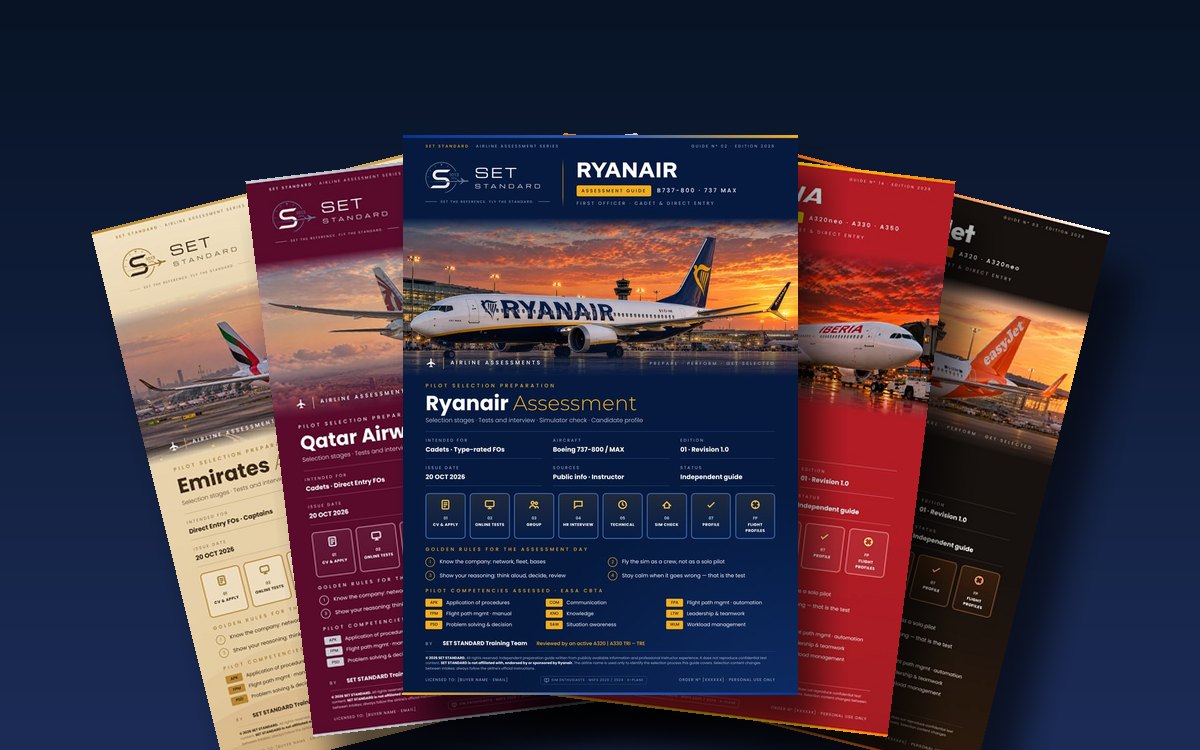
Airline-specific assessment guides
158 operator guides in the catalogue, 95–235 pages each, edition 2026: process, tests, interview, technical refresher and simulator profile.
Choose your airlineFrequently asked questions
Can you fail a pilot personality test?
There is no pass mark in the usual sense, but a profile that raises concerns, or one that appears inconsistent or unrealistically positive, can lead to rejection or to probing questions in the interview.
Should I answer how I think a pilot should answer?
No. Answer honestly about how you actually behave at work. Idealised answers tend to create inconsistencies and are difficult to defend later.
Is the personality questionnaire timed?
Often not strictly, but some have an overall time guide. Work steadily and go with your considered first response.
Will the interviewers see my personality results?
In many airlines, yes. The profile is often used to choose interview topics, so be ready to discuss it with examples.
Can I practise personality questionnaires?
You can familiarise yourself with the formats, which reduces surprise. Practising to change your answers is not useful; self-reflection is the real preparation.