SET STANDARD · Preparation guides
Pilot Aptitude Tests: What They Measure and How to Practise
Updated October 2026
Aptitude tests are usually the first serious filter in airline pilot selection. They are cheap to run at scale, they are standardised and they give the airline an objective view of the cognitive abilities that predict success in training and on the line: fast and accurate information processing, spatial understanding, attention management and reasoning under time pressure.
This page describes the main types of tests, the test systems candidates most often mention and a sensible way to practise. It does not reproduce any real test content. The goal is to help you understand the format, build the underlying skills and arrive on test day without surprises.
Why airlines use aptitude tests
Flying a modern airliner demands constant monitoring, quick mental calculation, the ability to build a three-dimensional picture from instruments and the capacity to handle several tasks at once without losing priorities. Aptitude tests sample these abilities in a controlled setting.
For ab-initio cadets, results help predict who is likely to complete training efficiently. For experienced pilots, tests are often a screening step to confirm baseline capacity before the more expensive interview and simulator stages.
The main types of pilot aptitude tests
Test batteries differ between providers, but the abilities they target are broadly similar. Most campaigns include several of the following categories, often with strict time limits and adaptive difficulty.
- Numerical: mental arithmetic, percentages, ratios, speed-distance-time and reading data from tables or graphs
- Verbal: comprehension of written passages, logical conclusions from text and, often, aviation English
- Spatial: mental rotation, interpreting instrument displays and orienting yourself relative to a map or heading
- Multitasking: tracking a moving target while monitoring other inputs and answering questions
- Reasoning: abstract patterns, sequences and rules, sometimes called inductive or deductive reasoning
- Attention and memory: concentration over time, short-term memory and detection of changes
Common test systems candidates encounter
Several names come up repeatedly in pilot selection. Knowing who provides the tests helps you understand the format, but remember that each airline chooses its own combination and settings, and that providers update their products over time.
cut-e, now part of Aon's assessment business, offers short online ability tests that many employers, including airlines, use as an early screen. COMPASS is a computer-based aptitude battery from European Pilot Selection and Training, used by a number of flight schools and operators. PILAPT, developed by People Technologies, is a pilot aptitude battery used in civil and military selection. Several European airlines use selection procedures developed with, or modelled on, those of the German Aerospace Center (DLR), which are known for demanding cognitive and psychomotor tests.
Mollymawk is different: it is an online practice platform that offers exercises in the style of common pilot aptitude tests. It is a training tool, not an official airline test.
How aptitude tests are scored
Most tests compare your results with a reference group rather than with a fixed pass mark. That means you do not need perfection; you need to perform reliably above the level the airline has set for its campaign.
Speed and accuracy usually both count, and some tests penalise wrong answers more than unanswered ones. Read the instructions carefully on the day. If guessing is penalised, it is often better to skip a question than to answer at random. Some batteries also look at the consistency of your performance across a test, so a steady pace usually serves you better than a fast start and a tired finish.
How to practise effectively
Short, regular practice beats occasional marathons. Twenty to forty minutes a day over several weeks lets your performance stabilise, while long sessions mostly train fatigue. Track your results so you can see which categories are improving and which are not.
Focus on the skills behind the tests rather than on memorising items. Mental arithmetic, for example, improves quickly with daily drills and is useful in the cockpit too. Spatial and multitasking skills respond well to varied practice tools, but the transfer is better when you also understand the strategy behind each task.
- Start with a timed diagnostic test to find your weakest categories
- Drill mental maths daily: multiplication tables, fractions, percentages, time and fuel calculations
- Practise multitasking in short blocks and focus on prioritisation, not panic
- Simulate test conditions: quiet room, same time of day, no interruptions
Test day: practical advice
Many first-stage tests are taken online at home, so prepare the environment as seriously as an exam room: stable connection, compatible device, a mouse or joystick if requested, and no notifications. For on-site tests, arrive early and rested.
Pace yourself. If a question is taking too long, move on when the format allows it. After each test, reset mentally and do not dwell on how the previous one went.
Fitting aptitude tests into the wider assessment
Strong test scores open the door, but they rarely get you the job on their own. Plan your time so that aptitude practice does not crowd out interview preparation, technical revision or simulator training. SET STANDARD's airline-specific assessment guides indicate which test categories each operator is reported to use, so you can prioritise your practice instead of trying to cover everything.
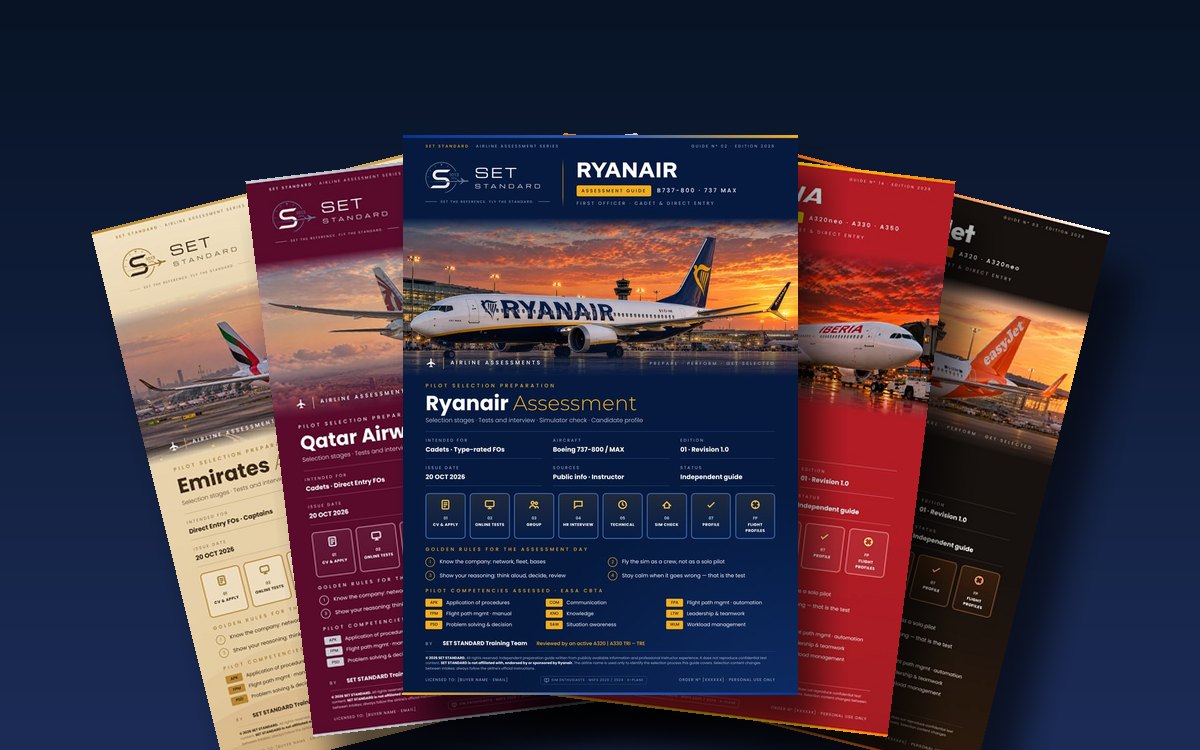
Airline-specific assessment guides
158 operator guides in the catalogue, 95–235 pages each, edition 2026: process, tests, interview, technical refresher and simulator profile.
Choose your airlineFrequently asked questions
Can you really improve your aptitude test scores with practice?
Yes, within limits. Familiarity with the format and regular training of skills such as mental arithmetic usually produce clear gains, especially for candidates who have never seen this kind of test.
Which aptitude test will my airline use?
Airlines rarely publish full details and may change providers between campaigns. Invitations often name the provider or the categories; experiences shared by recent candidates can also help.
Are calculators allowed in pilot aptitude tests?
Usually not for numerical tests designed to measure mental arithmetic. Always read the instructions you receive, as rules vary.
How long before the test should I start practising?
Ideally several weeks. A daily routine over four to six weeks is generally enough to become comfortable with the formats and improve weak areas.
Is Mollymawk the same as the real airline test?
No. It is a practice platform with exercises in a similar style. It can be useful for training, but the real tests may look and feel different.