SET STANDARD · Preparation guides
Pilot Assessment Guide: How Airline Selection Works and How to Prepare
Updated October 2026
An airline pilot assessment is the structured process an operator uses to decide whether a candidate is likely to become a safe, effective and trainable member of its flight crew. Whether you are a cadet applying to an ab-initio programme or a type-rated first officer moving to a new carrier, the logic is the same: the airline wants evidence of aptitude, knowledge, behaviour and handling skills, gathered in a way that is fair and repeatable.
This guide explains the stages you are most likely to meet, what assessors are really looking for at each one and how to build a preparation plan that works. It is written from the perspective of an instructor and examiner who sees candidates on both sides of the table, so the focus is practical: fewer myths, more method.
What an airline pilot assessment actually measures
Most selection processes are built around a competency model. In Europe, airlines increasingly align their criteria with the pilot competencies described by ICAO and EASA for evidence-based training: application of knowledge, application of procedures, communication, flight path management (manual and automated), leadership and teamwork, problem solving and decision making, situation awareness and workload management.
Each stage of the assessment samples some of these competencies. Aptitude tests look at cognitive capacity, the group exercise looks at teamwork and communication, the interview explores motivation and past behaviour, and the simulator shows how you fly and manage a crew environment. No single stage decides everything, but a clear weakness in one area can stop the process.
- Aptitude: can you process information quickly and accurately?
- Knowledge: do you understand the aircraft, the environment and the rules?
- Behaviour: will you work safely and constructively in a two-pilot crew?
- Handling: can you fly accurately and manage the flight path under workload?
The typical assessment pipeline
Every airline designs its own sequence, and the order can change between campaigns. Even so, most pipelines follow a recognisable pattern that moves from cheap, scalable screening to expensive, individual evaluation.
Ab-initio programmes tend to weigh aptitude and personality more heavily, because the airline is predicting trainability. Direct-entry and type-rated campaigns tend to put more weight on the technical interview and the simulator, because the airline expects operational maturity from day one.
- Online application and document screening (licences, hours, medical, right to work)
- Online aptitude tests and, often, a personality questionnaire
- Assessment day: group exercise, further tests and briefings
- Competency-based HR interview and technical interview
- Simulator assessment, sometimes as a separate day
- Final checks: references, medical confirmation, background checks
Preparing for aptitude and personality tests
Aptitude tests reward familiarity with the format as much as raw ability. The goal of practice is not to memorise questions but to remove surprises: how the screen looks, how much time you have and how the scoring treats speed versus accuracy.
Personality questionnaires are different. There are no right answers to rehearse, and attempts to present an idealised profile usually show up as inconsistency. The best preparation is self-knowledge and honest reflection on how you actually behave at work.
- Practise mental arithmetic daily without a calculator
- Train short sessions under time pressure rather than long, tired ones
- Sleep well before test days; fatigue affects multitasking scores markedly
Group exercise and interviews
The group exercise is an observation of behaviour, not a debate to win. Assessors watch how you listen, how you contribute, how you handle disagreement and whether the group reaches a sound decision in time.
Interviews usually combine a competency-based part, where you describe real situations using a structure such as STAR, and a technical part covering aircraft knowledge, performance, meteorology and operational rules. Prepare examples from your own flying and working life and rehearse explaining technical topics simply and correctly.
The simulator assessment
The sim check is where many candidates feel most pressure, yet it is also the most predictable stage once you understand it. Typical profiles include raw-data manual flying, departures, holds, approaches and a go-around, sometimes with a non-normal event. Type-rated candidates may be asked to fly a profile closer to a line or proficiency check.
Assessors grade more than accuracy. They look at briefing quality, use of checklists, callouts, workload distribution between pilot flying and pilot monitoring, and how you recover when something drifts. A calm correction is worth far more than a perfect start followed by a loss of awareness.
Building a realistic preparation plan
Start four to eight weeks before the expected test date if you can. Divide time between daily aptitude practice, structured technical revision and behavioural preparation, and book simulator practice early enough to fix habits rather than just rehearse.
Research the specific airline: its fleet, network, operating philosophy and the stages its campaigns usually include. SET STANDARD publishes airline-specific assessment guides prepared by airline training professionals, which can help you focus your effort on the format you will actually face.
- Weeks 1-2: diagnostic tests, technical gap analysis, collect STAR examples
- Weeks 3-5: targeted practice, mock interviews, first simulator sessions
- Final week: light review, logistics, rest and a clear head
Common mistakes that cost candidates the job
Most failures are not caused by a lack of talent but by avoidable errors in preparation or attitude. Recognising them early is one of the easiest gains available.
- Over-practising aptitude tests and neglecting the interview
- Reciting memorised answers that do not match the question
- Dominating or disappearing in the group exercise
- Flying the simulator alone instead of as a crew
- Not knowing basic facts about the airline you are applying to
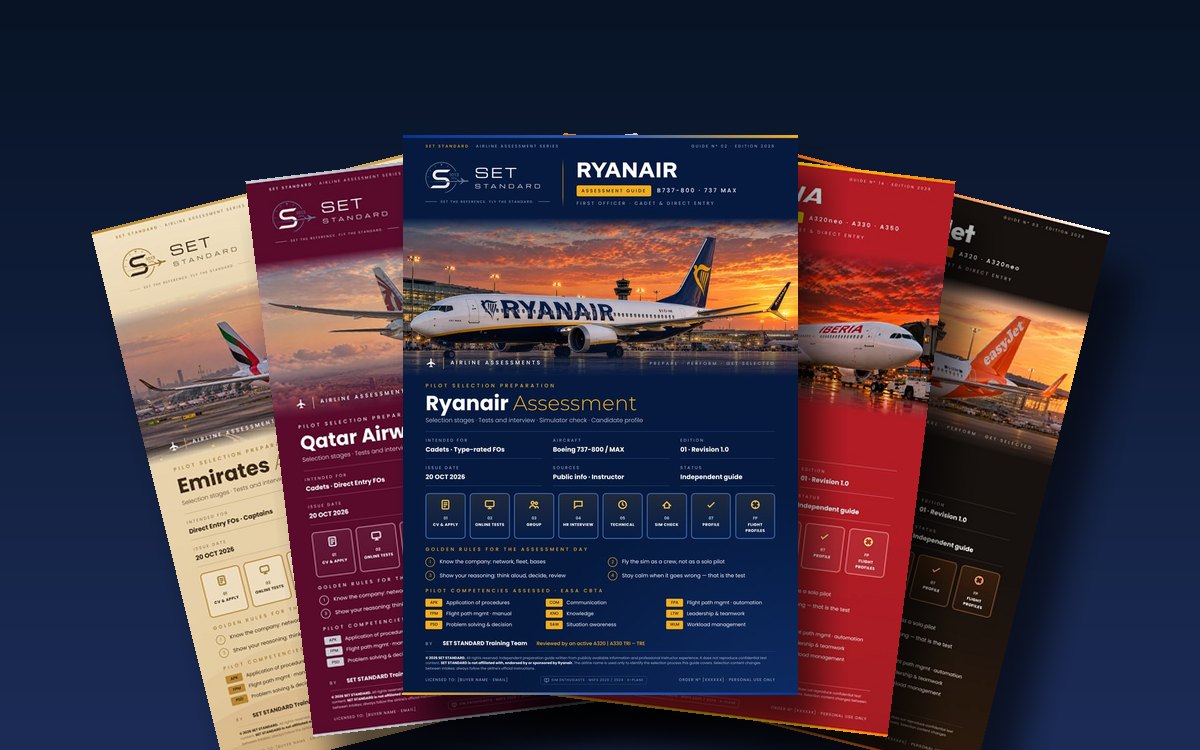
Airline-specific assessment guides
158 operator guides in the catalogue, 95–235 pages each, edition 2026: process, tests, interview, technical refresher and simulator profile.
Choose your airlineFrequently asked questions
How long does an airline pilot assessment take?
It varies by airline. Online screening may take a few weeks, and the assessment stages themselves are often spread across one to three days, sometimes with weeks between them.
Can I retake an airline assessment if I fail?
Many airlines allow a new application after a waiting period, often between six months and two years. Check the specific operator's policy before applying.
Do I need a type rating to pass a simulator assessment?
Not usually. Cadet and non-type-rated campaigns use profiles designed for candidates without the type, often flown in a sim of the airline's fleet with a brief familiarisation.
What is the most important stage of the assessment?
There is no single decisive stage. Airlines combine the evidence from all stages, but a clear safety or behavioural concern in any one of them can end the process.
How should I start preparing for a pilot assessment?
Begin with an honest diagnosis: take a timed practice test, review your technical knowledge and write down real examples for competency questions. Then build a plan around your weakest areas.