SET STANDARD · Preparation guides
Pilot Interview Questions: How to Prepare Competency and Technical Answers
Updated October 2026
The interview is where an airline tries to understand who you are as a pilot and colleague. Most panels combine two elements: a competency-based part, usually led by HR or a senior pilot, and a technical part that checks your knowledge and your ability to explain it. Both are designed to predict how you will behave on the line.
Below you will find how competency interviews are structured, how to use the STAR method, how the EASA and ICAO pilot competencies relate to the questions, and 20 example questions written for practice, each with short guidance. They are not taken from any airline's question bank; they illustrate the type of question you are likely to face.
How airline pilot interviews are structured
A typical panel has two or three interviewers: often someone from HR or recruitment and one or two line pilots, training captains or managers. The interview may last from thirty minutes to well over an hour, and the competency and technical parts can be held together or separately.
The tone is usually professional and friendly, but the questions are deliberate. Interviewers follow up, ask for details and sometimes challenge your answer to see how you react under mild pressure.
Competency questions and the STAR method
Competency questions ask you to describe a real past situation, on the principle that past behaviour is a good predictor of future behaviour. The STAR structure keeps answers focused: describe the Situation, your Task or responsibility, the Action you personally took and the Result, including what you learned.
Spend most of your answer on the Action. Interviewers want to hear what you did and why, not a long story about the context. Use first person, be specific and be honest about mistakes; a well-reflected error is often a stronger example than a flawless success.
The EASA and ICAO pilot competencies
Many European airlines build their interview around the pilot competencies used in evidence-based training. Preparing at least two genuine examples for each one gives you a solid base to answer almost any behavioural question.
- Application of knowledge
- Application of procedures and compliance with regulations
- Communication
- Aeroplane flight path management, automation
- Aeroplane flight path management, manual control
- Leadership and teamwork
- Problem solving and decision making
- Situation awareness and management of information
- Workload management
10 example HR and competency questions
Use these to practise structured, honest answers. Prepare real examples from flying, work, study or sport.
- Why do you want to fly for this airline? Show research: fleet, network, culture, and how they fit your goals.
- Tell us about a time you disagreed with a colleague. Show respectful assertiveness and a safe outcome.
- Describe a decision you made with incomplete information. Explain how you gathered data and managed risk.
- Give an example of a mistake you made. Own it, explain the correction and what you changed afterwards.
- Tell us about a time you were under high workload. Focus on prioritisation and delegation.
- Describe a situation where you led a team. Highlight direction, support and listening.
- When did you have to follow a rule you disagreed with? Show compliance and correct reporting channels.
- Tell us about receiving critical feedback. Demonstrate openness and concrete improvement.
- Describe a time you noticed a safety issue. Show that you spoke up and followed it through.
- Where do you see yourself in five years? Be realistic and committed to the airline.
10 example technical questions
Technical questions test understanding, not recitation. Answer simply, then add detail if invited.
- What affects take-off performance? Mention weight, temperature, pressure altitude, wind, runway slope and condition.
- What is V1? The maximum speed at which a rejected take-off can be initiated, and the minimum to continue after an engine failure.
- Why does stall speed increase in a turn? Load factor increases, so more lift is needed at the same angle of attack.
- Explain the coffin corner. At high altitude, the low-speed and high-speed limits converge.
- What hazards does a cumulonimbus present? Turbulence, icing, hail, windshear, lightning and heavy precipitation.
- What is density altitude and why does it matter? Pressure altitude corrected for temperature; it degrades performance.
- How does a swept wing affect handling? Higher critical Mach, but tendencies such as Dutch roll and tip stall.
- When do you need a destination alternate? Refer to the applicable operational rules and weather planning minima.
- What is the purpose of a stabilised approach? Predictable energy and configuration; otherwise, go around.
- Describe the hydraulic or electrical system of your current type. Know architecture and redundancy at a high level.
How to prepare for the interview
Write your examples down, rehearse them aloud and do at least one mock interview with someone who can challenge you. Revise the technical basics thoroughly rather than rare details. Know your CV and logbook, and prepare two or three questions of your own for the panel.
On the day, dress as you would for a professional briefing, arrive early and treat everyone you meet with the same courtesy. Listen to the whole question before answering, take a moment to think when you need it and ask for clarification rather than answering a question you have not understood.
SET STANDARD's airline-specific assessment guides summarise the interview format and recurring themes reported for each operator, so you can rehearse with the right emphasis.
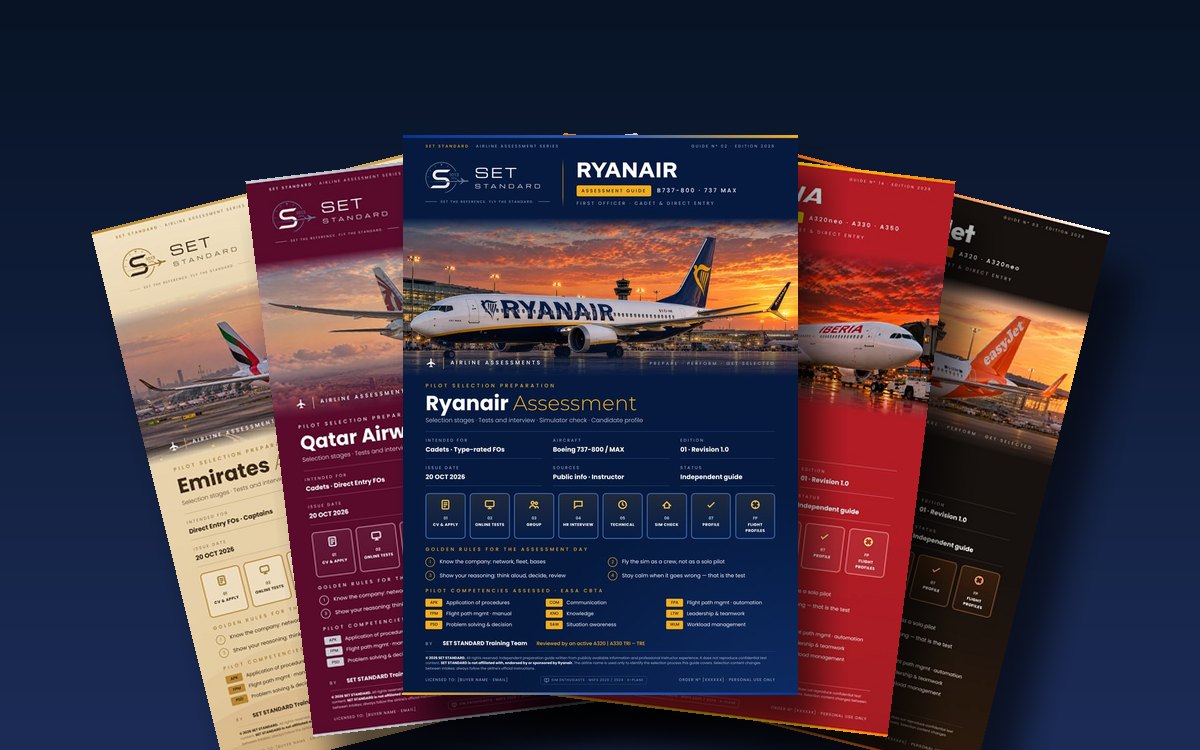
Airline-specific assessment guides
158 operator guides in the catalogue, 95–235 pages each, edition 2026: process, tests, interview, technical refresher and simulator profile.
Choose your airlineFrequently asked questions
How many STAR examples should I prepare?
Aim for at least two real examples per competency. Some examples can cover several competencies, but variety prevents repetitive answers.
Can I use non-aviation examples?
Yes, especially if you are a cadet. Examples from work, study, sport or volunteering are valid as long as they show the behaviour asked about.
What if I do not know the answer to a technical question?
Say so honestly, explain what you do know and how you would find the answer. Guessing confidently is worse than admitting a gap.
Are interview questions the same at every airline?
The themes are similar, but each airline has its own style, priorities and level of technical depth.
Should I memorise my answers?
Memorise the key points of each example, not a script. Recited answers sound unnatural and often fail to fit the exact question.