Entry routes · AFCAT · AFSB · CPSS · medical
Indian Air Force pilot selection and AFCAT preparation
Updated 31 October 2026 · SET STANDARD · sources checked 23–31 October 2026
Available now · instant download On sale
Look inside · 5 sample pages · All guides in the Pilot Shop →
Secure payment on Stripe (card, Apple Pay, Google Pay) · VAT included · download link by email straight after payment · single-user licence
Becoming a pilot in the flying branch of the Indian Air Force (IAF) means choosing the right entry route, passing a written examination, getting through the Air Force Selection Board (AFSB) and the Computerised Pilot Selection System (CPSS), and being declared medically fit by the Air Force medical board.
The four entry routes to the flying branch
NDA · National Defence Academy
After Class 12 · UPSC examination
- NDA I 2026: born 1 Jul 2007 – 1 Jul 2010
- Unmarried; Physics and Mathematics in Class 12
- Three years at NDA Khadakwasla, then Air Force Academy
CDS · Air Force Academy
Graduates · UPSC examination
- CDS II 2026: born 1 Jul 2003 – 1 Jul 2007
- Degree with Physics and Mathematics at 10+2, or BE
- Permanent commission (men only via CDSE)
AFCAT · Flying branch
Graduates · IAF examination
- AFCAT 01/2026: born 2 Jan 2003 – 1 Jan 2007 (CPL holders from 2 Jan 2001)
- Maths and Physics in 10+2 plus a qualifying degree or BE
- Short Service Commission; men and women
NCC Special Entry
Graduates · NCC Air Wing cadets
- Senior Division Air Wing “C” certificate
- Applies through the AFCAT notification of the same cycle
- No written AFCAT test; goes straight to the AFSB
Ages, education percentages and marital rules differ by route and cycle. The guide sets them side by side in an eligibility matrix with the paragraph of each notification.
The AFCAT exam
| Format | Online test · 100 questions · 300 marks · 2 hours (AFCAT 01/2026) |
|---|---|
| Marking | +3 for a correct answer, −1 for a wrong answer, 0 if left blank |
| Sections | Verbal ability in English · General awareness · Numerical ability · Reasoning and military aptitude |
| Cycles | Two a year (AFCAT 01 and 02). AFCAT 02/2026: applications 20 May – 19 Jun 2026, exam 8 Aug 2026, courses from July 2027 |
| Next cycle | Check careerairforce.gov.in for the AFCAT 01/2027 notification |
With +3/−1 marking a random guess among four options is worth zero on average, while an informed guess (one option eliminated) adds marks on average. The guide works through this with the numbers, alongside timed practice.
AFSB and CPSS, step by step
- Stage I screening. Officer Intelligence Rating test and Picture Perception & Discussion Test on the first day; candidates who do not qualify are sent back the same day.
- Psychological tests. Thematic Apperception Test, Word Association Test, Situation Reaction Test and Self Description.
- Group tasks. Group discussion, group planning exercise, progressive and half group tasks, individual obstacles, command task and lecturette (formats as reported).
- Personal interview with an interviewing officer.
- CPSS for candidates recommended for the flying branch: a computer-based test of instrument reading and multitasking that no paper exercise reproduces. It is a once-in-a-lifetime test under the AFCAT rules.
- Medical examination at an Air Force medical establishment, then a merit list.
Medical and physical standards
The 2026 AFCAT notifications give a minimum height of 162 cm for pilots; the NDA I 2026 notice records 163 cm. Vision, refractive surgery and other conditions are set out in the medical appendix of each notification, and only the medical board decides fitness. The guide separates what the official text says, what a candidate can check in advance, and what only the board decides, and it does not recommend any treatment “to pass”.
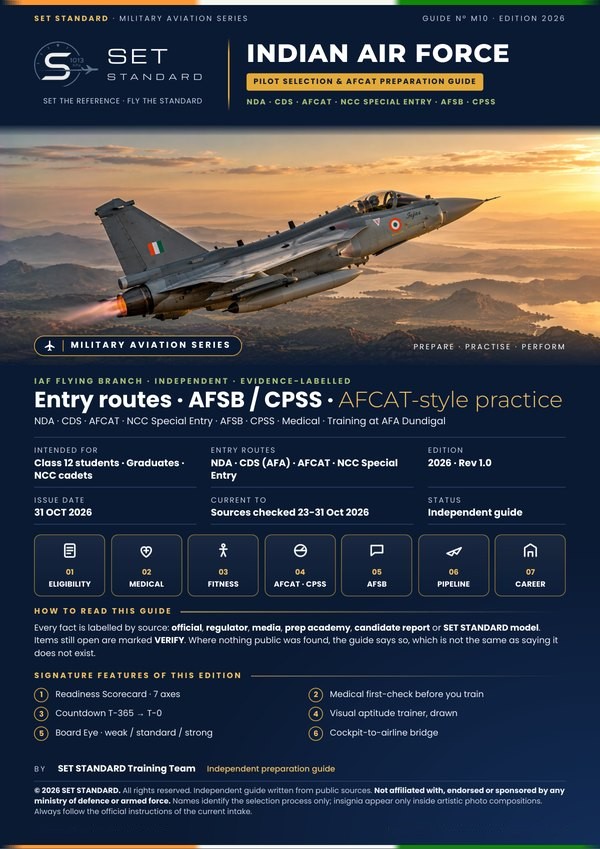
Get the complete Indian Air Force Pilot Selection & AFCAT Preparation Guide
157 pages, Edition 2026 · Revision 1.0: readiness scorecard, eligibility matrix by route, AFCAT-style practice (332 original items including a full-length 100-item practice mock with worked solutions), visual aptitude trainer, AFSB psychology and group practice, board interview preparation, training pipeline and checklists. Every fact is labelled by its source and date.
Look inside the guide€39.90 VAT incl. · digital edition, personal licence · on sale now · secure payment by card in euros
Paying from India? Use a Visa or Mastercard with international online payments enabled in your bank app. RuPay cards and UPI are not accepted.
About this guide
- Format
- PDF (bookmarked, fillable forms, iPad-optimised)
- Language
- English
- Edition
- Ed 2026 · Revision 1.0
- Current to
- 31 October 2026
- Pages
- 157
- Price
- €39.90 VAT incl. · on sale now
- Licence
- Personal, single user · see licence terms
- Institutions
- Academy licences are a separate product · info@setstandard.es
Independent publication. Facts are labelled official, reported or SET STANDARD model — see the editorial standards. Notify me about this guide · See it in the catalogue
Frequently asked questions
What are the ways to become a pilot in the Indian Air Force?
There are four entry routes to the flying branch: the UPSC NDA examination after Class 12 (with Physics and Mathematics), the UPSC CDS examination for graduates (Air Force Academy), the AFCAT examination conducted by the Indian Air Force, and the NCC Special Entry for holders of the NCC Air Wing Senior Division C certificate. Each route has its own notification, age band and education rules.
What is the AFCAT exam pattern?
In the AFCAT 01/2026 notification the online test has 100 questions, 300 marks and a duration of two hours. Each correct answer earns 3 marks, each wrong answer costs 1 mark and unanswered questions score zero. It covers verbal ability in English, general awareness, numerical ability, and reasoning and military aptitude.
What happens at the AFSB?
At the Air Force Selection Board, Stage I (an officer intelligence rating test and a picture perception and discussion test) screens candidates on the first day. Those who pass go on to psychological tests, group tasks and a personal interview over the following days. Candidates recommended for the flying branch also take the Computerised Pilot Selection System (CPSS).
Can I retake the CPSS?
According to the AFCAT notifications, the CPSS is a once-in-a-lifetime test, and a candidate who previously failed the CPSS or the earlier pilot aptitude battery is not eligible for the flying branch through AFCAT. Check the paragraph in your own notification, because the wording applies to its route and cycle.
What is the minimum height for an IAF pilot?
The 2026 AFCAT notifications give 162 cm for pilots; the NDA I 2026 notice records 163 cm. Each figure applies only to its own route and intake, so read the medical appendix of your notification; only the medical board decides fitness.
Is this an official Indian Air Force publication?
No. It is an independent preparation guide published by SET STANDARD, not affiliated with the Indian Air Force, the Ministry of Defence or UPSC. It does not replace the official notification, decide eligibility or medical fitness, or guarantee selection.
Preparation guides
Other military pilot entry guides
Main sources
https://careerairforce.gov.in/ (AFCAT 01/2026 and 02/2026 notifications)
https://afcat.cdac.in/AFCAT/
https://upsc.gov.in/ (Notice 3/2026-NDA-I; Notice 11/2026-CDS-II)
https://pib.gov.in/
SET STANDARD is an independent training publisher, not affiliated with the Indian Air Force, the Ministry of Defence or UPSC. This overview does not replace the official notification, decide eligibility or medical fitness, or guarantee selection.